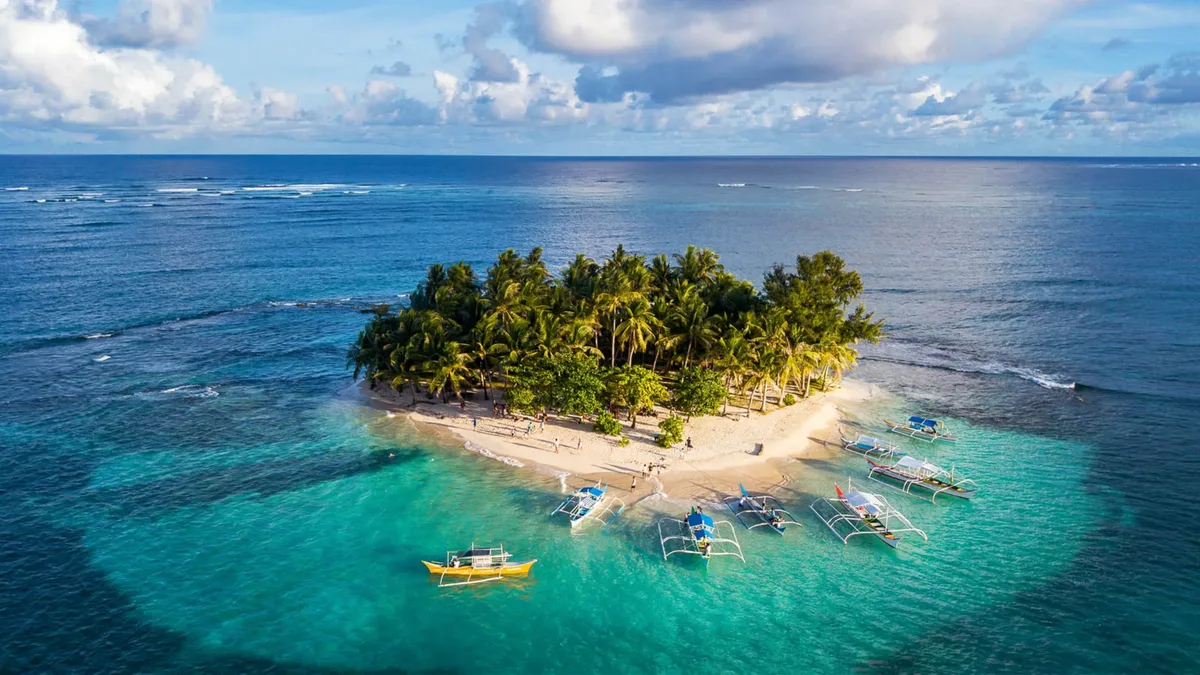
Getting to Siargao in 2026 is still straightforward — but the picture has changed enough this year that the advice you read in a 2024 blog post is now wrong in places. Philippine Airlines pulled its turboprops out of Manila in March. It then suspended its own Clark-to-Siargao flights in May, leaving Cebgo and Sunlight Air on that route. The new Sayak Airport terminal has opened. Below is what I would tell a guest arriving at Kawayan Villa tomorrow — flight by flight, hub by hub, fee by fee.

I have been booking transfers from Sayak Airport for guests since 2009. In that time I have watched three runways resurfaced, two terminals built, a typhoon close the airport for ten weeks, and four airlines come and go on the Cebu route. This guide is what I would tell a friend planning their first trip — current to September 2026, owner-verified, no aggregator filler. — David Frachou, owner
- The Short Answer — At a Glance
- How to Get to Siargao from Manila
- What Changed in 2026
- The Step-by-Step Roadmap
- All Current Routes to Siargao
- Manila vs Cebu vs Clark — Which Hub?
- Sayak Airport — What to Expect on Arrival
- From the Airport to General Luna
- The Surigao Ferry Alternative
- Bringing a Surfboard? Read This First
- Visa, eTravel & Immigration
- Connecting from Your Region
- Weather, Cancellations & Insurance
- 12 Common Mistakes to Avoid
- Frequently Asked Questions
The Short Answer — At a Glance
If you read nothing else, this is the answer: fly into Cebu, then take the 55-minute hop to Siargao. Three airlines now operate Cebu–Siargao, which is the redundancy you want when monsoon weather closes the airport for half a day. Total flight time from a major Asian hub is six to ten hours including layover; from the US West Coast it is around 22 hours door-to-door; from Western Europe, 24 to 28 hours via a Gulf carrier.
There is no direct flight from Manila NAIA to Siargao in 2026. Cebu Pacific moved its Manila-Siargao service to Clark on 30 March 2025, and Philippine Airlines suspended its Clark-Siargao route on 4 May 2026. From Manila you connect through Cebu (the easy option) or transit to Clark by road and fly Cebgo or Sunlight Air. From Clark, two carriers still operate.
Be ready for a gap between the advertised fare and what you actually pay. Cebu Pacific's "from PHP 1,200" headline does not include the fuel surcharge, web admin fee, 12% VAT, aviation security fee, or any checked baggage — and those add up. Real-world all-in cost per person, with one checked bag, booked four to six weeks ahead:
- Cebu – Siargao round-trip: around PHP 8,000 to 12,000 (~ USD $140 – $215)
- Clark – Siargao round-trip: around PHP 10,000 to 14,000 (~ USD $175 – $250)
- Manila → Cebu → Siargao round-trip (both legs combined): around PHP 14,000 to 20,000 (~ USD $250 – $360)
- Airport transfer to General Luna: PHP 300 to 500 per person shared, or 2,500–4,000 per private van
How to Get to Siargao from Manila
There is no direct flight from Manila to Siargao. Some travel sites still say there is — they are out of date. From Manila you have three real options, and which one is right depends on whether you are short of time or short of budget.
Option 1 — Fly Manila → Cebu → Siargao (the easiest)
Fly from NAIA to Cebu (about 1 hour 25 minutes) on Cebu Pacific or Philippine Airlines, then take the 55-minute hop to Siargao on Cebgo, PAL Express or Sunlight Air. With a sensible layover the whole trip takes four to five hours. Expect around PHP 14,000 to 20,000 round-trip, all-in with one checked bag. This is what I recommend to almost every guest: several flights a day, three airlines, and a fallback if one cancels.
Option 2 — Go to Clark and fly direct
Clark is the only airport on Luzon with a nonstop flight to Siargao. Take the P2P bus from Manila to Clark (about 2 hours), then fly direct — about two and a half hours — with Cebgo (about twice daily) or Sunlight Air (several times a week). Around PHP 10,000 to 14,000 round-trip. One flight instead of two, but fewer departures to fall back on. Philippine Airlines no longer flies this route.
Option 3 — Take the 2GO ferry (the cheapest)
Since late 2025 there is a weekly ship from Manila to Siargao. According to 2GO Travel's published schedule, it leaves Manila on Monday at 6:30 PM and arrives in Siargao on Tuesday at 11:30 PM — about 29 hours — with fares from around PHP 2,000 one way and a 50 kg luggage allowance. The return leaves Siargao on Wednesday at 2:30 AM and reaches Manila on Friday morning, because the ship continues through Butuan and Ozamiz first. It suits travellers with more time than budget, or a lot of luggage. It is one sailing a week, and routes like this can change — confirm with 2GO that it is sailing before you plan around it.
Not to be confused with the short Surigao–Dapa ferry further down, which is the backup when the airport closes.
What Changed in 2026
Three changes this year are big enough that they reshape the planning advice that worked in 2024 and 2025. If you have visited before, read this section even if you skip the rest.
Cebu Pacific / Cebgo ended Manila NAIA → Siargao direct (30 March 2025). The route was relocated to Clark, with new flight numbers DG 6759/6760 and DG 6761/6762 (Clark–Siargao). The old NAIA-departing flights (DG 6837–6842) no longer exist. As of 2026, no airline operates a direct flight between Manila NAIA and Siargao.
PAL ended all NAIA turboprop service (29 March 2026). Philippine Airlines moved its turboprop flights — including any Manila–Siargao operations — from Ninoy Aquino International to Clark International Airport, then suspended several routes including Clark–Siargao a few weeks later.
PAL's Clark–Siargao route was suspended indefinitely from 4 May 2026. Flight PR2875/PR2876 was one of five routes Philippine Airlines cut amid the 2026 regional jet-fuel crisis. No resumption date has been published.
Sunlight Air launched Clark–Siargao in April 2026. Partial replacement for the PAL service. Sunlight Air now flies from both Cebu and Clark to Siargao.
Sayak Airport's new passenger terminal is open, after groundbreaking in August 2025. Pre-departure capacity has gone from 200 to 750, and check-in counters from three to nine — visible relief for peak-season travellers.
The net effect for an international traveller: Cebu is now the strongest hub by a wider margin than ever. Three carriers, multiple daily flights, redundancy when weather closes a slot. Manila NAIA no longer has a direct flight to Siargao — you connect through Cebu or transit to Clark by road. From Clark, PAL is out, and Cebgo or Sunlight Air are the options.
The Step-by-Step Roadmap
Five steps from booking to your villa gate. The order matters — eTravel registration in particular has to happen before you board.
Lock your international long-haul into Manila (NAIA) or Mactan-Cebu (CEB) first, then book the Siargao hop. Booking the domestic leg too early can mean a forced overnight in Cebu if your international leg shifts. Aim for at least 3 hours of layover in Manila (NAIA terminals are far apart) or 2 hours in Cebu.
Visit etravel.gov.ph, fill in your passport and flight details, save the QR code on your phone. Free, takes ten minutes. Airline staff check the QR code at the boarding gate — without it you do not fly.
Visa-free entry for 30 days for US, EU, UK, Australia and most major nationalities. Have your onward ticket on your phone — immigration sometimes asks. Move efficiently to your domestic terminal; NAIA Terminal 2 / 3 / 4 transfers can take 45 minutes.
From Manila NAIA there is no longer a direct flight to Siargao — connect through Cebu (55 minutes, three carriers, multiple daily) or transit to Clark by P2P bus (about 2 hours) and fly Cebgo or Sunlight Air. From Cebu the hop is 55 minutes; from Clark, about 2 hours. Aim for a morning flight in monsoon season — afternoon weather diversions are common.
A 45 to 60 minute drive from Sayak (in Del Carmen) to General Luna. Pre-book a shared van (300-500 pesos per person) or have your villa arrange a private transfer. At Kawayan Villa we send a driver who waits for delayed flights — the only sustainable option if you are landing on the last flight.
All Current Routes to Siargao
Sayak Airport (IAO) — sometimes called Siargao Airport — is served by three carriers from three origin cities: Cebu, Clark and Davao. The table below is current as of late September 2026. Schedules and routes change frequently, especially this year — always confirm with the airline before booking.
| Route | Carriers | Frequency | Aircraft | Status |
|---|---|---|---|---|
| Cebu (CEB) – Siargao | Cebgo (5J/DG) · PAL Express · Sunlight Air | Multiple daily, 5:00am – 2:55pm | ATR-72 · Dash 8 Q400 | Operating |
| Clark (CRK) – Siargao | Cebgo · Sunlight Air | Cebgo twice daily · Sunlight Air several times a week | ATR-72 | Operating |
| Davao (DVO) – Siargao | Cebgo (Cebu Pacific) | About one flight a day | ATR-72 | Operating |
| Manila NAIA (MNL) – Siargao | — | — | — | Ended 30 Mar 2025 (Cebgo moved to Clark) |
Direct flights from Clark are operating with Cebgo and Sunlight Air. Only Philippine Airlines stopped its own Clark–Siargao flight, on 4 May 2026 — PAL still flies to Siargao from Cebu. Sources: Cebu Pacific advisory (March 2025), Philippine News Agency, Philippine Airlines and Sunlight Air route information, re-checked September 2026. AirSWIFT and AirAsia Philippines do not currently operate to Siargao.
Sample fares — what you really pay (booked 4–6 weeks ahead, 2026)
The headline price on Skyscanner and the airline sites is the base fare only. By the time you finalise the booking, fuel surcharge, web admin fee, 12% VAT, aviation security fee, and one piece of checked baggage have roughly doubled (or more) what was quoted. The numbers below are all-in totals for one adult with a 20kg checked bag — the figure you actually pay at checkout.
- Cebu – Siargao round-trip: PHP 8,000 to 12,000 (~ USD $140 – $215)
- Clark – Siargao round-trip: PHP 10,000 to 14,000 (~ USD $175 – $250)
- Manila → Cebu → Siargao round-trip (both legs combined): PHP 14,000 to 20,000 (~ USD $250 – $360)
- Davao – Siargao round-trip: PHP 7,000 to 11,000
Fares roughly double again if you book within two weeks of travel, around Holy Week, school holidays or the Philippines Pro window (October 31 – November 10). The 2026 fuel-crisis surcharges are also adding 15–25% to base fares compared with 2024 — a real, ongoing factor, not a one-week spike.
A "from PHP 1,200" Cebu–Siargao one-way fare on Cebu Pacific is built up at checkout with: fuel surcharge (PHP 800–1,500 in 2026), web admin fee (~PHP 200), aviation security fee (~PHP 200), 12% VAT on the fare, seat selection if you want a specific seat (PHP 300–500), and checked baggage (PHP 600–1,100 for 20kg, depending on route). A 1,200 base fare commonly finalises around PHP 4,000–5,000 per one-way.
To get closer to the headline price: travel carry-on only (Cebu Pacific allows one 7kg cabin bag free), skip seat selection, and decline travel insurance at the upsell step.
Manila vs Cebu vs Clark — Which Hub?
This is the single decision that shapes the rest of your itinerary. Here is how I advise guests, by region of origin.
Cebu — the recommended hub for almost everyone
Three airlines, multiple daily flights, 55-minute flight time, and direct international service from Hong Kong, Singapore, Tokyo, Seoul and Taipei (no Manila stop required). When weather closes the morning Sayak flight you usually have another option two hours later. Cebu hotels in the Mactan/Lapu-Lapu area are walkable from the international terminal if you need a forced overnight.
The trade-off is an extra layover compared to a Manila direct, but in monsoon season the redundancy is worth it. Almost every Australian and Asian guest we host now routes via Cebu and saves four to six hours of NAIA terminal-shuffling.
Manila (NAIA) — no direct flight; you must connect
This is the change that catches the most travellers in 2026: there is no direct flight from Manila NAIA to Siargao. Cebu Pacific / Cebgo relocated their Manila–Siargao service to Clark on 30 March 2025. PAL never operated a NAIA–Siargao after their March 2026 turboprop exit. From NAIA you have two practical options: fly NAIA → Cebu → Siargao (the easier path, two short hops on Cebu Pacific or PAL), or take the P2P bus to Clark (about 2 hours road transit) and fly Cebgo or Sunlight Air from there.
Clark (CRK) — convenient if you can transit, fewer options after May 2026
Clark is roughly 80 kilometres / two hours north of central Manila by road, served by P2P bus from EDSA, Trinoma and Pasay (around 250–400 pesos). With PAL's Clark–Siargao route suspended from 4 May 2026, the Clark options have thinned to Cebgo (Cebu Pacific's regional arm, which moved here from NAIA in 2025) and Sunlight Air (Clark service launched April 2026). If your international flight lands at Clark (still rare for most long-haul), the route works well; if it lands at NAIA, the ground transfer to Clark usually negates the schedule advantage versus going via Cebu.
Sayak Airport — What to Expect on Arrival
Sayak Airport (IATA: IAO, ICAO: RPNS) sits in the municipality of Del Carmen on the north-west of Siargao Island, about 49 kilometres from General Luna. It is a single-runway, turboprop-only airport. There are no jet-bridge gates, no international flights, and until recently, no terminal worth a queue.
That last part is changing. The new passenger terminal — groundbreaking 8 August 2025, 95.2 million peso budget, 8-month modular build, designed by Filipino architects — is expanding pre-departure capacity from 200 to 750 passengers and adding six new check-in counters (three to nine total). Terminal floor space roughly doubles from 716 to 1,531 square metres. Solar panels and rainwater harvesting are part of the design.
The build was timed to be ready for the Philippines' 48th ASEAN Summit (5–9 May 2026, hosted in Cebu) and is now open and operational. If you visited before 2026, the new terminal will be the first thing you notice.
What does NOT change with the new terminal
One single runway. Turboprop-only — no widebody jet service planned in the near term. And critically, the runway lacks robust instrument-landing aids strong enough to allow landings in monsoon-grade low visibility — meaning weather diversions to Surigao (or wait-then-cancel) remain a real possibility for the November–February window.
Sources: Philippine News Agency (8 August 2025), Department of Tourism release (9 August 2025), Sayak Airport — Wikipedia.
From the Airport to General Luna
Almost every guest we host has the same first question on arrival: "Do I need to book a transfer?" The short answer is yes, in advance — especially if you land after dark. Sayak is small. When the last flight lands at six in the evening and eighty people walk out of the gate at once, the van queue is real.
Three practical options:
- Shared van — 300 to 500 pesos per person, 45 to 60 minutes, departs when full. Pre-bookable via Klook, KKday, GetYourGuide or local operators. Most guests do this for budget trips.
- Private van — 2,500 to 4,000 pesos per vehicle (your group), faster, door-to-door, driver waits for delayed flights. The right call for families, longer stays, or any landing after 5pm. Kawayan Villa arranges this for arriving guests by default — the driver knows the road, knows the villa gate, and waits if your flight is late.
- Tricycle — 500 to 800 pesos with bargaining. Slow and uncomfortable on the 49km route. Not recommended for international guests with luggage.
Two small fees you will encounter: a 20-peso environmental fee per guest collected at the airport (Municipality of Del Carmen / Dapa ordinance), and 350 pesos per excess luggage piece on shared vans. Negligible in absolute terms, worth knowing.
For everything else about the villa side of arrival, see the FAQ and the Surf Retreat page. Once you have landed and dropped your bags, our Things to Do in Siargao guide is the next step.
The Surigao Ferry Alternative
The ferry is not the romantic option. It is the backup option — and in monsoon season, when the 7am Sayak flight cancels and you are stuck in Cebu, knowing the ferry route exists has saved more than one of our guests' trips.
The route works in two legs: first you fly or sail to Surigao City on the Mindanao mainland, then take a 90-minute fastcraft across the strait to Dapa Port on Siargao.
Surigao City to Dapa, Siargao
Two operators run this crossing daily, with around six total round-trips. Up-to-date schedules are published on Pamasahe, which is what most regulars use:
- Evaristo & Sons fastcraft — Surigao departures around 06:00, 10:00 and 13:00; Dapa departures around 06:00, 10:00 and 13:00. Roughly 90 minutes. Fare 420 to 520 pesos.
- Evaristo & Sons RORO — slower vehicle ferry, one afternoon departure each way (~15:30). Cheaper, ~2 hours.
- Montenegro Shipping Lines RORO — Dapa departures 05:00 and 11:00. Vehicle ferry, ~2 hours.
Getting to Surigao City
By air: Surigao Airport (SUG) is served only by Cebgo (Cebu–Surigao, 50 minutes) as of March 2026. By overnight ferry: Cebu City to Surigao on Cokaliong Shipping or Trans-Asia, 9 to 10 hours, around 1,000 pesos. The overnight ferry is a real budget option but most international visitors prefer to fly the leg.
Dapa Port to General Luna
From Dapa Port it is a 20 to 30 minute tricycle ride to General Luna — 250 to 300 pesos for the ride. Shared vans run about 300 pesos per person. Confirm the price before climbing in: first-quote-at-port tends to be inflated.
Weather caveat: the strait gets cancelled when the Philippine Coast Guard issues a small-craft advisory. We saw multiple ferry cancellations during the low-pressure system on 9 March 2026 that also closed the airport. Plan a buffer day in Surigao or Cebu if you are travelling November to February.
Bringing a Surfboard? Read This First
After years of booking transfers for surf-trip guests, my single most repeated piece of advice: if you are flying with a surfboard, book Philippine Airlines (PAL Express), not Cebu Pacific. Cebu Pacific's surfboard policy is genuinely painful in practice — only two board slots per flight, a strict 6-foot length cap, app-only booking that has to be done well in advance, and brittle counter staff when things go wrong. PAL accepts surfboards as part of standard checked baggage, the staff at the surf counter know what a surfboard is, and the Q400 turboprop has more cargo room than the ATR. The Cebu–Siargao route is your best PAL option since the Clark route is suspended.
That said, here are the actual policies so you can plan around them — starting with the airline I now recommend first.
Philippine Airlines / PAL Express — the easier option
- Treatment: Surfboards are accepted as part of your standard checked-baggage allowance if they fit the size and weight envelope (158 cm linear, 23 kg economy on international fares; domestic varies)
- Special-baggage handling: Available — PAL has a published sports-equipment policy that explicitly lists surfboards
- Aircraft on Cebu–Siargao: DHC-8 Q400 turboprop, which has more cargo capacity than the ATR-72
- How to add: Call PAL or use Manage Booking on philippineairlines.com after purchase. Confirm at check-in.
- Real-world fee: Often falls inside your existing baggage allowance — no separate add-on charge for many fares
Cebu Pacific / Cebgo (ATR-72) — the hard road
- Maximum length: 6 feet (1.83 m). Firm. Boards over 6 feet rejected at the gate
- Maximum weight: 20 kg per board
- Maximum bookings per flight: 2 surfboards total (route-level, not per-passenger)
- Per passenger limit: 1 board booking
- How to add: via the Cebu Pacific Special Baggage page or app under "Add-ons" before booking, latest 2 hours before departure — if you forget, you cannot add it at the counter
- Excess weight: billed at standard excess-baggage rates separately
- Slot risk: 2-board limit means if you are the third surfer on the flight, you do not fly with a board even if it is under 6 feet
The combination of the 2-per-flight cap, the 6-foot length cap, the app-only booking, and the inflexibility at check-in is why I tell board-carrying guests to skip Cebu Pacific entirely for this trip. If you have already booked Cebu Pacific, add the surfboard add-on the moment you book the ticket — these slots sell out for the Philippines Pro window and peak season.
Sunlight Air
Sports/special baggage accepted on ATR-72 with similar size constraints to Cebu Pacific. Published pricing is less detailed than the bigger carriers — contact Sunlight Air directly before booking if you are bringing a board.
The longboarder problem
Even on PAL, longboards over the standard 158 cm linear limit incur special-baggage handling. Practical answers:
- Rent locally. Cloud 9 and Jacking Horse surf shops stock 7'0–9'2 longboards in good condition. Standard daily rentals around 500–800 pesos. This is what almost every visiting longboarder does.
- Ship via cargo. Slower (several days), reliable for those staying a month or more, route via Cebu freight forwarders.
- Borrow at the villa. If you are staying with us, talk to David — we have boards on site for guests.
Visa, eTravel & Immigration
Visa-free entry for 30 days
Under Executive Order 408, citizens of more than 150 countries — including the United States, the United Kingdom, all EU member states, Australia, Canada, New Zealand, Japan, South Korea, Singapore and Hong Kong SAR — are granted 30 days of visa-free entry on arrival. The standard conditions:
- Passport valid for at least 6 months beyond your intended stay
- Proof of onward or return travel within 30 days (airlines enforce this strictly at boarding)
- Sufficient funds for your stay
Need longer? Visa extensions are routine at any Bureau of Immigration office — a Visa Waiver extension gives you 29 more days for around 3,000 pesos, processed in a single visit. Cebu has the closest BI office.
eTravel — mandatory for every foreign traveller
The eTravel registration is the single most-missed step in trip planning. It is mandatory regardless of nationality or visa status. Visa-free entry does not exempt you. Register free at etravel.gov.ph within 72 hours of your arrival flight.
What you need: a valid passport, your flight details, an accommodation address (Kawayan Villa's address is on your booking confirmation), and an active email. No documents to upload. Takes under ten minutes. The system generates a QR code that you must show at the boarding gate and at Philippine immigration.
If you forget — and forgetting is the most common single failure point in my guest experience — you can register at the airport before boarding. But the airline gate agent will absolutely not let you board without it, even with an otherwise valid ticket.
Connecting from Your Region
From the United States
From the US West Coast (LAX, SFO, Seattle), Philippine Airlines is the major direct operator to Manila with daily-or-better service. From 1 June 2026 PAL is ramping Manila–LA from 14 to 18 weekly flights. United operates SFO–Manila direct. Cebu Pacific runs seasonal LAX/Honolulu service. From the US East Coast (JFK), PAL operates Manila direct.
Typical SFO–MNL is around 14 hours direct. Total LAX–IAO (via Manila and Cebu) is about 22 hours door-to-door. Approximate round-trip fares: USD $725 to $1,200 depending on season and how early you book.
From Europe (UK, EU)
No direct flights to Manila from Western Europe in 2026. The standard routings go via a Gulf or Asian hub:
- Qatar Airways — London, Paris, Frankfurt, Amsterdam → Doha → Manila (daily, often the smoothest single-connection option)
- Emirates — Dubai connection, similar daily service
- Singapore Airlines — via Singapore, can also continue to Cebu direct (skip Manila entirely)
- Turkish Airlines — via Istanbul, often the best fares
Total transit 24 to 28 hours. From Singapore you have the option to fly direct to Cebu and bypass Manila — saves four to six hours.
From Asia (Singapore, Hong Kong, Tokyo, Seoul, Taipei)
Direct service to Cebu is available from all five hubs — bypass Manila entirely:
- Singapore → Cebu: Scoot, Cebu Pacific direct
- Hong Kong → Cebu: Cebu Pacific, Cathay Pacific
- Tokyo (Narita) → Cebu: Philippine Airlines direct, plus Cebu Pacific
- Seoul (Incheon) → Cebu: Korean Air, Asiana, Cebu Pacific
- Taipei → Cebu: EVA Air, Cebu Pacific
Total transit from Asian hubs to Siargao: 6 to 10 hours including layover. This is the most efficient routing for our Asian guests — and the one we steer them toward.
From Australia & New Zealand
Sydney and Melbourne both have direct flights to Manila on Philippine Airlines and Cebu Pacific. Qantas codeshares on PAL. From Manila, connect through Cebu — there is no direct Manila–Siargao flight. Sydney–MNL is around 9 hours.
For Auckland, transit via Sydney or Brisbane. Total NZ–Siargao around 18 to 22 hours.
Weather, Cancellations & Travel Insurance
About 10% of all Sayak Airport flights experience weather-related delays or cancellations year-round. That rate jumps sharply in the northeast monsoon (November to February), when low-pressure systems and occasional typhoons can close the airport for days. The 9 March 2026 incident — when 1,140 passengers were affected across three airlines and 25 spent the night at the airport — is the textbook recent example.
Siargao's actual typhoon risk window is December to January, not the generic Philippines typhoon season. For the why behind that, see our Best Time to Visit Siargao guide — the cold-front-from-Japan mechanism that redirects typhoons across the southern Philippines. Late October and early November are the highest-demand window because of the Philippines Pro, the WSL Championship Tour's first Philippine stop (October 31 – November 10, 2026); if you are travelling for the contest, book the domestic leg the day you book your international flight — flights and accommodation both sell out months ahead.
The 2026 fuel crisis adds a layer
On top of normal weather risk, 2026 has produced a regional jet-fuel supply shock — a consequence of Middle East tensions and the Philippines' 98% Gulf-oil dependence. Jet fuel is up roughly 118% year-on-year, which is why PAL has been suspending routes through Q2. The energy emergency declared in early 2026 is the underlying driver. Expect occasional further route adjustments through the year.
Travel insurance — the one purchase I tell every guest to make
I have called insurance hotlines on behalf of three of our guests in the past two years — one reef cut needing stitches at the Dapa hospital, two scooter accidents requiring transfer to Cebu. The guests who had adventure-sports cover walked away whole. The ones who did not, paid out of pocket.
Specifically for Siargao, your policy needs to cover:
- Surfing as an explicit covered activity (most standard policies exclude it without an adventure rider)
- Medical evacuation — Siargao's medical capacity is limited and serious cases are airlifted to Cebu or Manila
- Trip interruption for the weather-cancellation risk
- USD $100,000 minimum emergency medical, $250,000+ medical evacuation
Providers our guests have used successfully: Tin Leg Adventure, Travel Insured FlexiPAX, World Nomads Explorer, Allianz Trip Care. Buy at the time you book — most policies have a window for trip-cancellation cover.
12 Common Mistakes to Avoid
Synthesised from seventeen years of guest arrivals. The most useful ones I have learned from guests' near-misses — not from a blog.
Frequently Asked Questions
What is the easiest way to get to Siargao in 2026?
Fly into Mactan-Cebu (CEB) and connect on a 55-minute hop to Sayak Airport (IAO). Three airlines now operate Cebu–Siargao — Cebgo (Cebu Pacific's regional arm), PAL Express and Sunlight Air — giving you carrier redundancy when weather closes a slot. There is no direct flight from Manila NAIA to Siargao: Cebu Pacific moved its Manila–Siargao service to Clark on 30 March 2025, and PAL's Clark–Siargao route has been suspended since 4 May 2026.
Which airlines fly to Siargao in 2026?
Three carriers serve Sayak Airport: Cebu Pacific / Cebgo from Cebu, Clark and Davao (no longer from Manila NAIA since 30 March 2025); PAL Express from Cebu (the Clark route was suspended 4 May 2026); and Sunlight Air from Cebu and Clark (Clark service launched April 2026). AirSWIFT does not currently operate to Siargao, and AirAsia Philippines has no Siargao route.
Is there a direct flight from Manila to Siargao?
No — not from Manila NAIA. Cebu Pacific / Cebgo moved their Manila–Siargao service from NAIA to Clark on 30 March 2025 (new flight numbers DG 6759/6760, DG 6761/6762). Philippine Airlines never operated a NAIA–Siargao after their 29 March 2026 turboprop exit. From Manila, the two practical options are: connect through Cebu (the easy route, multiple daily flights, three carriers) or transit to Clark by P2P bus (about 2 hours road) and fly Cebgo or Sunlight Air. Cebu is what we recommend for almost all international travellers.
Has the Sayak Airport terminal expansion opened?
The new passenger terminal at Sayak Airport broke ground on 8 August 2025 with an 8-month modular build, timed to be ready for the Philippines' 48th ASEAN Summit (5–9 May 2026). The expansion increases pre-departure seating from 200 to 750 passengers, adds six new check-in counters (3 to 9 total), and roughly doubles terminal floor area from 716 to 1,531 square metres. The new terminal is now open and operational.
Can I bring a surfboard on the flight to Siargao?
Yes — but the owner's recommendation is book Philippine Airlines (PAL Express), not Cebu Pacific. PAL accepts surfboards as part of standard checked baggage and the Q400 turboprop has more cargo room. Cebu Pacific's policy on the ATR-72 is painful: only 2 surfboard bookings per flight (route-level cap, not per passenger), a strict 6-foot length limit, 20 kg per board, and app-only booking at least 2 hours before departure. Longboards over 6 feet cannot be carried on Cebu Pacific to Siargao at all — most longboarders rent locally in General Luna instead.
How do I get from Sayak Airport to General Luna?
It is a 45 to 60 minute drive from Sayak Airport (in Del Carmen) to General Luna, where Cloud 9 and most resorts are located. A shared van transfer costs 300 to 500 pesos per person and departs when full. A private van for your group is 2,500 to 4,000 pesos. Most villa-style accommodations including Kawayan Villa arrange a transfer for arriving guests. Expect a 20-peso environmental fee per guest at the airport, plus 350 pesos per excess luggage piece on shared vans.
Do I need a visa to visit Siargao?
Citizens of the US, the UK, all EU member states, Australia, Canada, New Zealand, Japan and 150+ other countries get 30-day visa-free entry under Executive Order 408. Requirements: passport valid 6 months beyond your stay, proof of onward or return travel within 30 days, sufficient funds. Airlines enforce the onward-ticket rule strictly at boarding. Visa extensions are routine at any Bureau of Immigration office.
What is eTravel and do I need to register?
eTravel registration is mandatory for every foreign traveller entering or leaving the Philippines, regardless of nationality or visa status. Register free at etravel.gov.ph within 72 hours of arrival. You need a valid passport, flight details, an accommodation address, and an email. The system generates a QR code that you show at the boarding gate and at immigration. Visa-free entry does not exempt you.
Is the Surigao to Siargao ferry a good option?
It is a genuine backup, particularly in monsoon season when Sayak can close. Evaristo & Sons runs fastcraft from Surigao City to Dapa at roughly 06:00, 10:00 and 13:00 (1h 30m, 420–520 pesos), plus a slower RORO at 15:30. Montenegro Shipping Lines runs RORO at 05:00 and 11:00. From Dapa Port to General Luna is a 20–30 minute tricycle (250–300 pesos) or shared van (300 pesos per person). Cancellations happen in bad weather; check schedules the day before.
What is the cheapest way to get from Manila to Siargao?
The cheapest way is the weekly 2GO Travel ferry from Manila, if it is sailing — 2GO lists it with fares from around PHP 2,000 one way, so confirm the schedule with 2GO first. It takes about 29 hours, leaving Manila on Monday evening and arriving in Siargao late on Tuesday. The cheapest way by air is usually the P2P bus to Clark and a direct Cebgo or Sunlight Air flight, around PHP 10,000 to 14,000 round-trip all-in. Flying Manila–Cebu–Siargao is the easiest route and costs around PHP 14,000 to 20,000 round-trip.
How long does it take to get from Manila to Siargao?
By air via Cebu, four to five hours including the layover: about 1 hour 25 minutes to Cebu, then a 55-minute flight to Siargao. Via Clark, allow about 2 hours by road to Clark plus a direct flight of about two and a half hours. There is no direct flight from Manila. By sea, 2GO lists a weekly ferry that takes about 29 hours. Add 45 to 60 minutes from Sayak Airport to General Luna.
Which airport do you fly into for Siargao?
Sayak Airport (IATA code IAO), in Del Carmen on Siargao Island. It is a small airport served by turboprop flights from Cebu, Clark and Davao. From Sayak it is a 45 to 60 minute drive to General Luna and Cloud 9, where most visitors stay.
What happens if my flight to Siargao is cancelled?
Sayak Airport sees weather-related cancellations roughly 10% of the time year-round, rising sharply during the northeast monsoon (November to February). The airline rebooks you to the next available flight, but the ripple effect can mean a forced overnight in Cebu. Carry travel insurance with trip-interruption cover, build a buffer day if you have onward international connections, and avoid the last flight of the day in monsoon season. The Surigao ferry can save a delayed trip if you can reach Surigao City.
We Arrange Your Transfer — and We Wait
When you book Kawayan Villa Siargao, the airport transfer is part of what we handle. A private driver waits for delayed flights — no van queue at midnight after a 22-hour journey. Still comparing your options? Read our owner's pick of the best villas in Siargao 2026.