
There is no single best month to visit Siargao — there are three. April through July is the dry, sunny window, perfect for families and island hopping. June and July are the small-wave season, the year's best stretch for beginners, longboarders and kids learning to surf. August through November is peak surf at Cloud 9, with the biggest, cleanest waves of the year in September and October. Below is a month-by-month guide — written not from a press release but from nearly twenty surf seasons of watching this wave from my front gate.

I have lived 200 metres from Cloud 9 since 2007. In that time I have watched nearly twenty seasons turn over, from the small clean waves of June to the heaviest December storms. This guide is what I would tell a friend planning their first trip — not what an aggregator article assembles from web searches. — David Frachou, owner
- Siargao at a Glance — Month by Month
- Siargao's Seasons in Plain English
- The Month-by-Month Breakdown
- Best Time to Surf in Siargao
- Best Time for Island Hopping & Lagoons
- Who Should Visit When
- The Honest Truth About Typhoon Season
- 2026 Update — Flights, Routes & the Airport
- The Philippines Pro 2026 — the World Tour Comes to Cloud 9
- What to Pack
- Frequently Asked Questions
Siargao at a Glance — Month by Month
Most "best time to visit" tables for Siargao reproduce the same weather-station data: average rainfall in millimetres, average temperature, and a column labelled "days of rain". That last column is the problem. Weather stations log a rain day for any precipitation that falls — even a ten-minute tropical burst on an otherwise sunny day. The result is tables that suggest fifteen rainy days a month in September. That is technically accurate and experientially wrong.
The table below uses the same station rainfall numbers, but replaces the misleading "rain days" column with an owner-verified pattern — what a guest will actually experience.
| Month | Rainfall | Avg Temp | What it really feels like |
|---|---|---|---|
| January | 416 mm | 26°C | Genuinely rainy — the wettest month |
| February | 312 mm | 27°C | Still rainy, easing late month |
| March | 183 mm | 28°C | Dry — the rain has stopped |
| April | 122 mm | 28°C | Almost no rain. Brief shower at most, then sun all day |
| May | 102 mm | 29°C | Driest of the year. Hottest of the year |
| June | 137 mm | 29°C | Almost no rain. Occasional brief afternoon burst |
| July | 140 mm | 28°C | Almost no rain. Small clean waves |
| August | 114 mm | 28°C | Occasional light showers. Mostly fine. Surf waking up |
| September | 125 mm | 28°C | Occasional light showers — not 15 full rainy days |
| October | 186 mm | 28°C | Occasional brief showers. Philippines Pro starts Oct 31 |
| November | 292 mm | 27°C | Showers increasing late month — transition |
| December | 373 mm | 26°C | Rainy — but heavy bursts, not 23 washout days |
Rainfall and temperature: Bohol Nature Tours station data for Siargao Island. Owner-verified pattern: David Frachou, nearly two decades' residence at Cloud 9.
Siargao's Seasons in Plain English
Siargao is officially classified as Climate Type II under the Philippine Modified Coronas system — meaning no pronounced dry season. The textbook reading of that is "rain can happen any time of year." That is technically true. It is also misleading enough to be wrong for travel planning.
In practice the island has two monsoons and three useful windows:
- Amihan — the northeast monsoon, roughly December to May. Cool, wet at the start, drier toward May. The wind blows directly onshore at Cloud 9.
- Habagat — the southwest monsoon, roughly June to November. Warm and humid, but the wind is offshore at Cloud 9 — and that is what creates the famous surf.
From those two monsoons come three windows:
- April through July: the dry, sunny window. Almost no rain. June and July are also the year's small-wave season.
- August through November: peak surf. Big clean swell, offshore wind, Cloud 9 firing. October is the heart of it.
- December through March: wet, rough seas, often big but blown-out surf. January and February are the only months that really feel like a rainy season.
KAWAYAN VILLA
Get our best rates before anyone else
Join our list for early access to low-season offers and villa news. A few emails a year — nothing more.
No spam. Unsubscribe anytime.
The Month-by-Month Breakdown
January — the wettest month
January is the rainiest month on Siargao, averaging 416 mm. Cloud 9 still gets swell — sometimes very large swell — but the northeast amihan wind blows onshore, making the face messy. Seas around the island are rough; island hopping is unreliable. Visitor numbers are low, prices are the cheapest of the year. Best for: budget travellers willing to accept the weather.
February — easing into the dry
February is still wet but lighter than January (312 mm), and the second half of the month often turns. Crowds are minimal, prices stay low. A good month for repeat visitors who already know Siargao and want a quiet, slow-travel stay. Best for: long-stay travellers, low-budget couples.
March — the rain stops
By March the heavy rain is behind, the island starts to dry out, and the first wave of returning visitors arrives. Seas calm down enough for island hopping by late month. Best for: early-bird island hopping, photography, dry-weather honeymoons before the Holy Week rush.
April — peak dry, but watch Holy Week
April is excellent weather (122 mm, mostly sunny) but also Holy Week 2026 falls 2–5 April, when Filipinos travel en masse and Siargao fills with domestic tourists. Flight prices spike 20–50%, accommodation books out, and General Luna becomes a different town for a week. Outside those four days, April is one of the best months of the year. Best for: island hopping, beach days, honeymoons — but book early and avoid the Holy Week window.
May — driest and hottest
May has the lowest rainfall of the year (102 mm) and the highest temperatures — daily highs have hit 36°C historically. Philippine summer school holidays sustain elevated domestic demand through about mid-May, then crowds ease. The wind has begun to swing southwest, cleaning up the small breaks around General Luna. Best for: families, photographers, anyone who wants reliable sunshine.
June — start of the small-wave season
June is the most underrated month on the island. The big winter swells have faded but the habagat wind has now properly arrived — offshore at almost every break around General Luna. The result is small, clean, perfectly-shaped waves and the lowest crowd density of the year. The General Luna town fiesta on 24 June (the feast of St. John the Baptist) adds a cultural anchor mid-month. Best for: beginner surfers, longboarders, kids learning to surf, value travellers.

July — small waves continue, perfect wind
July extends the small-wave season. Clean offshore SW wind, small rideable swell, the dozen breaks around General Luna all approachable for first-timers. Australian winter school holidays bring some international shoulder traffic but crowds remain manageable. Best for: beginner surfers, longboarders, families with kids, low-key island time.
August — surf wakes up
August is the transition month. The first proper Pacific-generated swells begin to push into Cloud 9, still inconsistent. Some weeks Cloud 9 fires; other weeks it is the only break working while the rest of the island stays small. International surf-tourism traffic builds. Best for: intermediate surfers, anyone who wants peak-season prices without peak-season crowds.
September — peak surf begins
September is when the wave that made Siargao famous comes to life. Clean 4-to-8-foot faces become routine. The international surf crowd arrives. Cloud 9 is regularly firing, Stimpy's and Tuason are working, and the boardwalk fills with photographers from sunrise. Rainfall is light (125 mm, mostly brief showers). Best for: advanced surfers, photographers, surf photographers.
October — peak everything
October is the heart of the year. And 2026 is historic: the Philippines Pro — the first WSL Championship Tour event ever held in the Philippines — starts at Cloud 9 on 31 October and runs to 10 November. Cloud 9 becomes a stadium, with the world's best surfers in town. Surrounding accommodation is booked months in advance. Even outside the contest window, October is the most reliable surf month of the year. Best for: the surf-trip-of-a-lifetime crowd, spectators, anyone who wants Siargao at full energy.
November — the tail of peak season
November is half peak season, half transition. In 2026 it opens with the Philippines Pro running through 10 November at Cloud 9. The first two weeks remain strong for surfers; the second half shifts as rainfall picks up (292 mm) and seas begin to rough up. Post-contest, the international crowd thins out. Best for: advanced surfers who want October waves without October prices — outside the contest window.
December — the risk month, but not a dead month for surf
December is complicated. Rainfall climbs to 373 mm, holiday travel inflates flight and accommodation prices around Christmas and New Year, and December is the start of Siargao's actual typhoon risk window — see the dedicated section below. Cloud 9 itself is messy: the swell is large but the wind has turned NE-onshore.
What aggregator articles miss is that this is exactly when Siargao's other breaks come alive. The same northeast amihan wind that blows Cloud 9 out is offshore at breaks facing the other direction. Stimpy's, the left on the far side of the bay, becomes the destination break. A handful of others around the island, only known by local surf guides, also start to fire. This is the single most important thing to understand about surfing Siargao year-round: different seasons, different breaks. The island has the wind and swell variety to give you a rideable wave somewhere — if you know where to look.
Best for December: advanced surfers travelling with a local guide who knows which break works on which wind. Not for anyone coming purely for Cloud 9, and not for travellers who can't afford to lose a few days to a passing storm.
Best Time to Surf in Siargao
If you read most "best time" articles about Siargao surf, you will come away with a two-window picture: peak season (August to November) and "off-season" (everything else). That is wrong. The real calendar has three windows, and the small one in the middle is the most commercially important window for travellers who are not professional surfers.
Window 1 — December to May: big swell, but Cloud 9 is blown out
Most aggregator articles say "Cloud 9 is flat from December to May." This is not accurate. The swell is still there — often massive — driven by Pacific rainy-season storm systems. What changes is the wind. The northeast amihan monsoon blows directly onshore at Cloud 9, blowing out the wave face and making it messy and unrideable on most days. The wave is present; the wind is the limiting factor. (For a live look at conditions before your trip, the Surfline Cloud 9 forecast is the standard reference.)
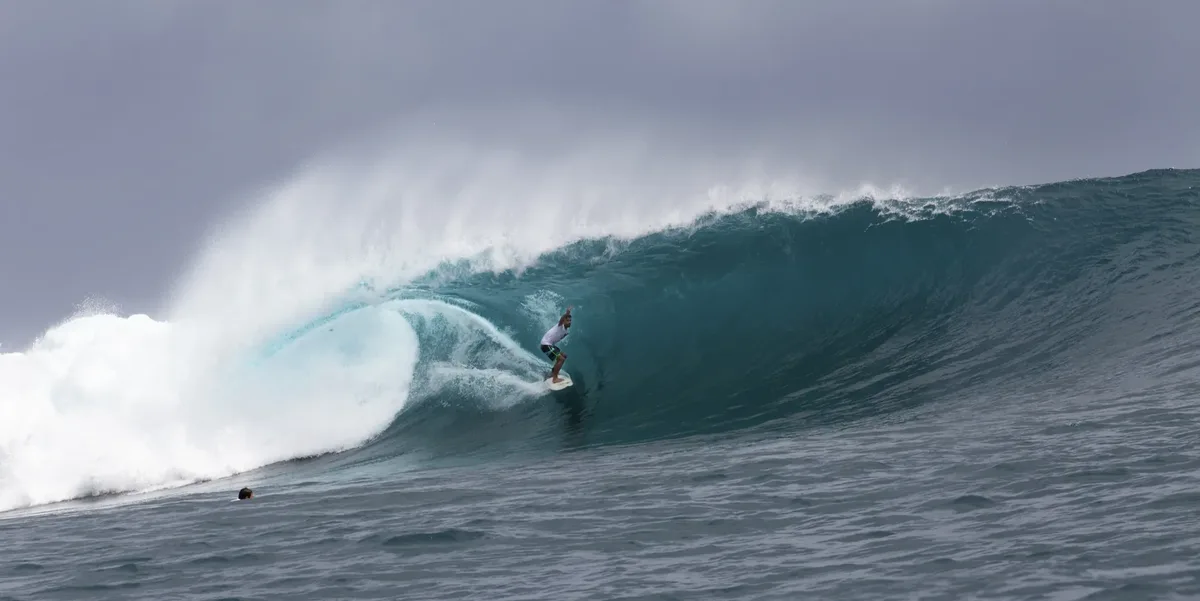
And here is what makes Siargao genuinely unique as a surf destination: the wind that blows Cloud 9 out is offshore at breaks facing the other direction. When Cloud 9 is messy in December and January, Stimpy's — the powerful left on the far side of the bay — becomes the destination break. A handful of other reefs around the island, mostly known only to local surf guides, also come alive on the amihan. The picture below was shot at Stimpy's, with me in the barrel — that wave was unrideable at Cloud 9 the same morning. Different seasons, different breaks. The island always has somewhere to surf if you know which wind sends you where, which is exactly why a local surf guide is more valuable in Window 1 than in any other window.
Window 2 — June to end of July: the small-wave season
This is the editorial gem of the Siargao calendar — the period no aggregator names properly. The big winter swells fade out, but small, clean, well-shaped waves take their place. The wind has rotated to the southwest habagat, which is offshore at almost every break around General Luna. The result is two months of near-perfect conditions for longboarders, beginners and kids. The breaks fire small enough that first-timers can paddle out without the intimidation factor of peak Cloud 9, and the wind keeps the faces clean rather than blown out. Jacking Horse and Quicksilver — both right-hand reef breaks, both genuinely beginner-friendly — are the standard learner spots. If you are bringing kids or learning to surf, this is the window.
Window 3 — August to November: Cloud 9 fires
From August through November the same southwest wind is now offshore against the much bigger Pacific-generated swell that has started arriving. That combination — clean swell plus offshore wind — is the formula that made Cloud 9 famous. September and October peak: 4–8 foot faces almost daily, sometimes bigger. The other named breaks come alive too: Stimpy's (left, advanced, handles 10ft+ pulses), Tuason (left, expert-only, very shallow and technical), Pacifico (left, gentler when Cloud 9 is too big). For a complete guide to the wave itself, see the Cloud 9 destination guide.
Best Time for Island Hopping & Lagoons
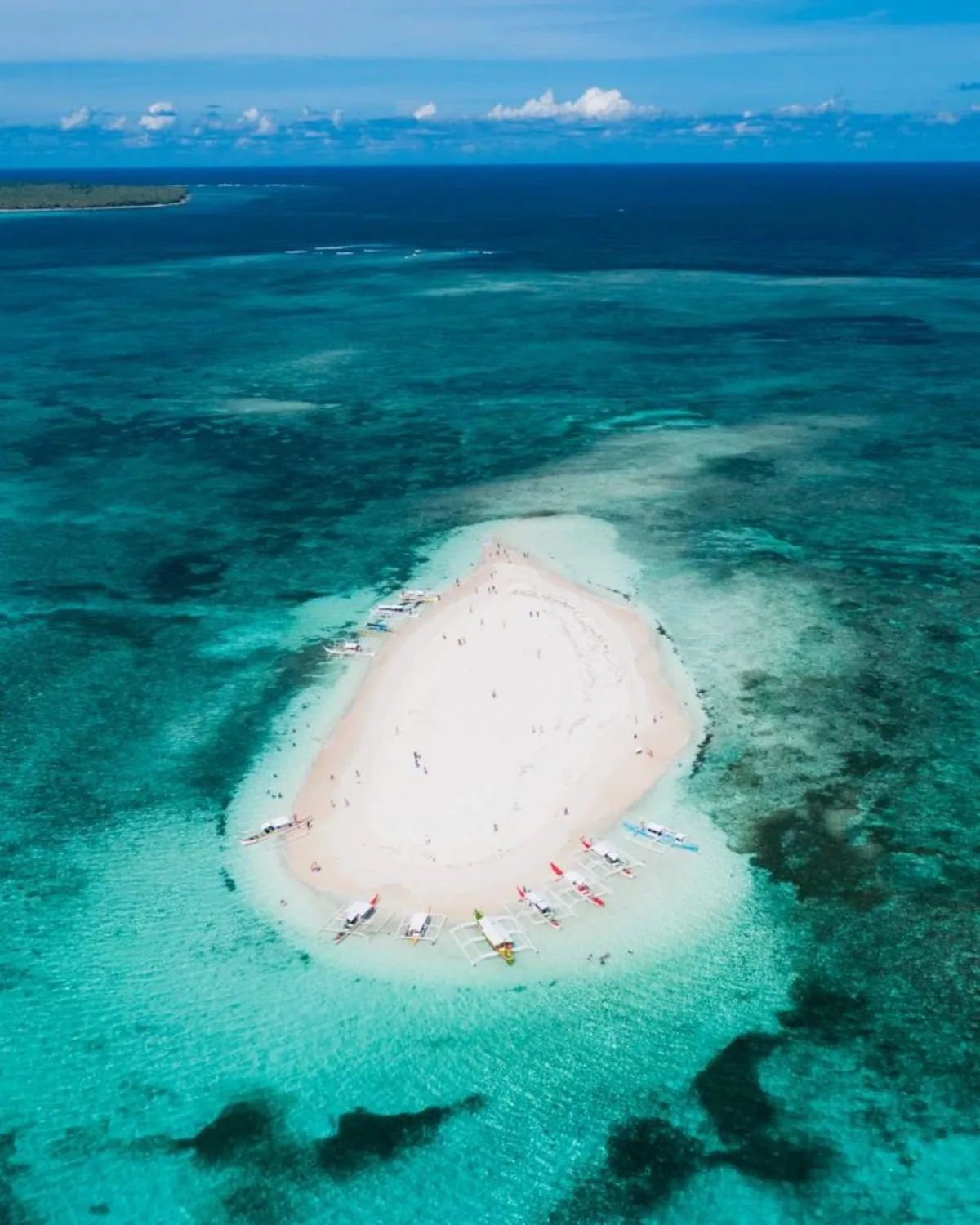
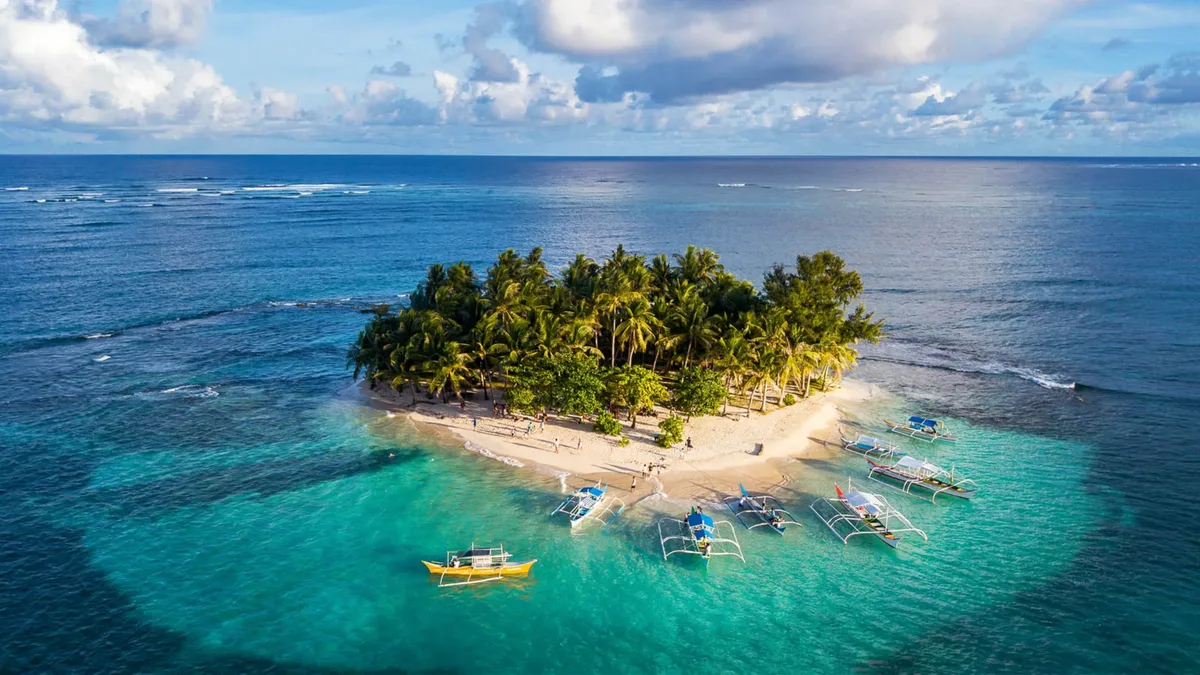
Cloud 9 is the famous wave, but island hopping is the experience most guests remember longest. The classic Siargao day-trip — Naked Island (a bare sandbar at low tide), Daku Island (long beach with grilled lunch) and Guyam Island (a small palm-covered rock) — depends entirely on calm seas and good visibility.
The seasonal pattern is straightforward:
- March to May: the best three months. Calm seas, clear water, full visibility, every island visitable. Naked Island is at its best at low tide for the bare sandbar.
- June to October: shoulder. Seas calm enough most days, visibility good, occasional shower. Bookings still easy.
- November to February: rougher seas, more cancellations. Tour operators often pause day-trips when the wind picks up. Doable but unpredictable.
Magpupungko Rock Pools — the most-photographed natural pool on the island — is tide-dependent and only accessible at low tide. Sugba Lagoon and Sohoton Cove follow similar dry-season-best patterns. A full list of activities and timings is in the activities page.
For a structured day-by-day plan that builds around these windows, see the 3, 5 and 7-day Siargao itinerary.
Who Should Visit When

The single most common mistake in planning a Siargao trip is treating "best time to visit" as a one-size-fits-all question. It is not. Here is the audience-by-window breakdown:
If you are unsure which audience profile fits your trip — or you are travelling as a mixed group — message us directly. The villa has hosted every one of these profiles, and the calendar above is built from that pattern.
The Honest Truth About Typhoon Season
The generic answer most travel sites give is "Philippines typhoon season runs June to November." That range is technically correct for the western Pacific basin as a whole. It is misleading for Siargao specifically — and getting it right is one of the most important things this article can do.
Siargao's actual typhoon risk window is December to January. The reason is meteorological. In late autumn and early winter, a cold front pushes south from Japan over the western Pacific. The front acts as a steering barrier: typhoons that form in the basin can no longer track north over Luzon as they would in summer. Instead, the storms are deflected south, threading through the central and southern Philippines — and Siargao sits directly in that redirected path. The earlier-season typhoons that hit the Philippines (June through November) tend to track north over Luzon and dissipate inland; the ones that reach Siargao with destructive force tend to be the late-season storms that get pushed south by the cold front.
Super Typhoon Odette (Rai) is the textbook case. On 16 December 2021, Odette/Rai hit Siargao as a Category 5 system with maximum sustained winds of 195 km/h and gusts to 270 km/h. The storm intensified from Category 1 to Category 5 in roughly 24 hours, leaving residents little time to prepare. Total damage to Siargao alone was estimated at P20 billion, with General Luna town accounting for approximately three-quarters of the island's economic loss. The date — mid-December — is consistent with the cold-front redirection mechanism, not with the official June–November "season."
Recovery has been substantial. Power and communications returned within a month. Within seven months, resorts and visitor destinations had reopened and surfing tournaments had restarted under the local government's "Bangon Siargao" (Rise, Siargao) programme. The Cloud 9 Towers — the iconic three-storey watchtower destroyed in 2021 — are being rebuilt ahead of the Philippines Pro (October 31 – November 10, 2026).
The counterintuitive implication: Christmas and New Year visitors arriving for tropical sunshine are arriving into the actual risk window. Honest articles say so. The article you are reading is one.
Three concrete 2026 changes affect anyone planning a trip:
1. PAL turboprop relocation (29 March 2026): Philippine Airlines moved all turboprop services from Manila's NAIA to Clark International Airport. Travellers connecting from Manila now connect at Clark, or fly via Cebu.
2. PAL Clark–Siargao route suspension (4 May 2026): PAL suspended the direct Clark–Siargao route (PR2875/PR2876) indefinitely as part of a broader regional route trim driven by a fuel-price spike. Cebu–Siargao is now the most reliable connection — three airlines (Cebu Pacific, Cebgo, Philippine Airlines), approximately one-hour flight time.
3. Sayak Airport terminal expansion: The new passenger terminal has expanded pre-departure seating from 200 to 750 capacity, added six check-in counters, and lengthened the apron for larger aircraft. Arrivals are smoother than they were in 2024.
For the full picture — every current route, all-in fare ranges, surfboard rules, ferry alternatives, visa & eTravel and twelve common mistakes to avoid — see our dedicated How to Get to Siargao in 2026 guide.
The Philippines Pro 2026 — the World Tour Comes to Cloud 9
The surf peak now has a historic anchor: on July 1, 2026 the World Surf League elevated the Cloud 9 contest to a full Championship Tour stop. The Philippines Pro presented by the Philippine Sports Commission runs from 31 October to 10 November 2026 — the first CT event ever held in the Philippines, replacing the previously announced QS 6000 window of 16–25 October.
For Siargao, this is the biggest week in the island's history. The reduced late-season Championship Tour field — 24 men and 16 women, the World Title contenders — competes at Cloud 9. The boardwalk fills with photographers and spectators; General Luna fills with surfers, media crews and travellers from across the world. Watching is free — you can simply walk onto the boardwalk and stand metres from the heats.
If you want to be here for the Philippines Pro, dates need to be booked months in advance. The full guide is in the Philippines Pro 2026 article.
What to Pack — A Quick Note by Season
- April to July (dry, hot): light cotton, swimwear, reef-safe sunscreen, sun hat, light rash guard for sun protection. A light layer for boat trips if you are sensitive to wind.
- August to November (surf season): as above, plus surf gear if you brought your own. Most boards can be rented locally. A light waterproof jacket for the late-season showers from mid-October.
- December to March (wet): waterproof shell, a warmer layer for evenings, and acceptance that some days will be rained out. Excellent if you are coming to read by the pool and not to surf Cloud 9.
For booking-related questions about what is included at the villa, see the FAQ.
Frequently Asked Questions
What is the best time to visit Siargao?
It depends on what you came for. April through July is the driest and sunniest stretch — perfect for island hopping, families and beginners. June and July are the small-wave season, ideal for longboarders, kids and first-time surfers. August through November is peak surf season at Cloud 9, with the biggest, cleanest waves of the year in September and October. February and June are the best months for low prices and small crowds.
What is the rainy season in Siargao?
Siargao is officially Climate Type II — no pronounced dry season — but in practice the genuinely rainy months are December, January and February. From April through July the island sees almost no rain. When it does rain in the dry stretch, it is typically a short tropical burst followed by sunshine, not a full day of rain. Weather-station "days of rain" counts overstate the experience for tropical climates because they log any precipitation, even a ten-minute shower.
When is typhoon season in Siargao?
Siargao's actual typhoon risk window is December and January, not the generic June-to-November Philippines typhoon season. The reason: in late autumn and early winter a cold front pushes south from Japan and blocks typhoons from tracking north over Luzon, redirecting them through the central and southern Philippines and across Siargao. Super Typhoon Odette (Rai), which hit Siargao on 16 December 2021, is the textbook case.
Is Siargao safe to visit after Typhoon Odette?
Yes. Recovery from Odette (16 December 2021) was substantial within seven months. Resorts, restaurants, surf schools and the Cloud 9 boardwalk are fully operational. The Cloud 9 Towers are being rebuilt ahead of the Philippines Pro 2026. Local preparedness has been materially upgraded since 2021.
When is the best month to surf Cloud 9?
September and October — peak surf, clean 4-to-8-foot faces almost daily. August is the warm-up, November is the tail. The widely-quoted notion that Cloud 9 is flat from December to May is not accurate: the swell is often big year-round, but the northeast amihan onshore wind blows the wave out, making it messy rather than absent.
When should beginners learn to surf in Siargao?
June and July — the small-wave season. The big winter swells have faded, small clean waves take their place, and the southwest habagat wind is offshore and clean at almost every break around General Luna. Jacking Horse and Quicksilver are the standard learner spots, both right-hand reef breaks. This is also the same window that is best for kids learning to surf.
Is Siargao good to visit in November?
November is strong for advanced surfers — tail end of peak season at Cloud 9, smaller crowds than October. Less ideal for island hopping, with rougher seas late in the month. The first half of November is consistently better than the second half.
Is Siargao good to visit in May?
Yes — May is one of the best months. Driest weather of the year (about 102 mm of rain), the hottest temperatures (historical highs to 36°C), great visibility for island hopping, and Philippine summer school crowds ease toward late month. Cloud 9 is not yet in season, but the dozen smaller breaks around General Luna are starting to clean up as the wind transitions.
How do I get to Siargao in 2026?
The most reliable route is Cebu to Siargao — served by Cebu Pacific, Cebgo and Philippine Airlines, about one hour flight time. From Manila, connect through Cebu or via Clark International Airport, since PAL moved all turboprop services from NAIA to Clark on 29 March 2026. The direct Clark–Siargao route was suspended from 4 May 2026. Sayak Airport's new passenger terminal has expanded capacity from 200 to 750 pre-departure seats.
When is the Philippines Pro 2026 (formerly Siargao Surfing Cup)?
The Philippines Pro runs 31 October – 10 November 2026 at Cloud 9, General Luna. On 1 July 2026 the WSL upgraded the contest from a Qualifying Series 6000 to a full Championship Tour stop — the first CT event ever held in the Philippines, presented by the Philippine Sports Commission.
Plan Your Trip Around the Right Month
Kawayan Villa Siargao — the only fully private villa directly at the Cloud 9 surf break, 200 metres from the wave. Whichever month fits your trip, we have hosted that profile before.